
Transcript for (S7E4) Waking the Giant: How the Dayton Arcade Fueled a Downtown Comeback
SCOTT: All I tell you from the perspective of the rotunda is you look up and you see literally the history of Dayton in front of you.
Narration: The history of this small midwestern city in Ohio has long been defined by its big entrepreneurial spirit.
SCOTT: Dayton has a huge history, heritage and a history of innovation. The Wright brothers were here, right? Car batteries and car starters, the stepladder and Cheez-Its, I mean, who knew? Cheez-Its, the beer pull tap, you know, on a beer can. The old beer cans that was invented in Dayton. So all these great inventions. Um, it's not just powered flight, you know, the, the pole tab and then the pop top on your, can, you know, imal phrase, uh, Dayton reliable tool.
Um, a lot of people don't realize that, every time they open that Coke can, that's you. You could thank, um, Imal phrase and Dayton reliable tool for that. Um, you know, then you have things like. The stepladder and Cheez-Its, I mean, who knew? Cheez-Its, that's a, that's a staple, right? Um, self-starters air conditioning.
Dayton, to me is, is kind of the, you know, picture of entrepreneurship.
From the birthplace of flight to the first mechanical cash register to the home of cheese-its, Dayton's industrious history has an outsized importance in the Ohio River Valley and the nation as a whole.
But it's the so-called City within the city that defined Dayton's bustling downtown. The Dayton Arcade.
Narration: The sprawling nine-building Dayton Arcade built at the turn of the century, was modeled after the arcades, or indoor marketplaces, that dominated Europe at the time.
Functional but also beautiful - the soaring ceilings and domed glass rotunda at its center…90 ft. across and 70 ft. high, give the space an architecturally elegant feel.
SCOTT: That was the city square, the city market. Was on the site that you're standing, it's covered by this beautiful glass rotunda. you can see into the cityscape, you can see into the sky, but you realize that so much of the heritage and that history that existed in Dayton existed underneath your feet.
Narration: It's said that one-sixth of the population of Dayton would have passed through the "The City Within a City" every day…doing their daily shopping and errands at the public market and retail shops at the Arcade. There were even apartments and offices on the upper floors, making this a true mixed use complex for Daytonians to live, work and be in community.
But as Dayton’s economy and population changed and people left the city, the arcade eventually shut down. For 30 years it sat vacant and transformed from city center to eyesore - an impossible project that wasn't even worth the money to tear it down
DAVE: it was the giant because it couldn't be done.
Vince Lewis: There are Coke cans from the 1992 Olympics, the commemorative can, and a desktop calendar that has a date in like 1992 that is open to that date.
No desk. Everything else is gone, but all this stuff is in there. And it was really like a, you know, did we walk into a zombie movie?
Narration: Now nearly 3 decades since it was abandoned, and over a century since it was first built , after many failed attempts at restoration, redevelopment and even demolition, Cross Street Partners finally won the hearts, minds and funding to revive and redevelop this long-vacant landmark.
Narration: It’s been reborn as a mixed-use district with housing, events, food and retail - centered around the HUB. the largest University-anchored innovation center in the country.
DAVE: : The history of Dayton was really written in this space. It was the center of economy, the center of commerce for the city for a hundred plus years. So you're seeing a new rebirth of that, a new re-imaging of that. but it is, it's like no other space I've seen. It's just stunning.
Narration: Today we're looking at the Dayton Arcade, a bold project honoring the history of a small but mighty city with an ambitious downtown redevelopment project.
Vince Lewis: Dayton is the entrepreneurial spirit.
Taylor: I think it's built into what Dayton's known for, you know, ingenuity, invention, innovation, taking a in disrepair, uh, building or development just the history of Dayton and how far we've come. You know, Dayton is a city of fighters and, um, it's just really fun to be a part of it.
Eva: but taking it and refurbishing it and making it unique, making it a jewel of, uh, community.
Narration: I'm your host, Brian Maghn Chief Marketing and Innovation Officer at Fidelity National Financial, and this is Built, where you’ll meet creative leaders in commercial real estate. This season, we’re going BOLD. Big ideas, Defining places, And the people who make them real.
Seg A Waking the Giant: History
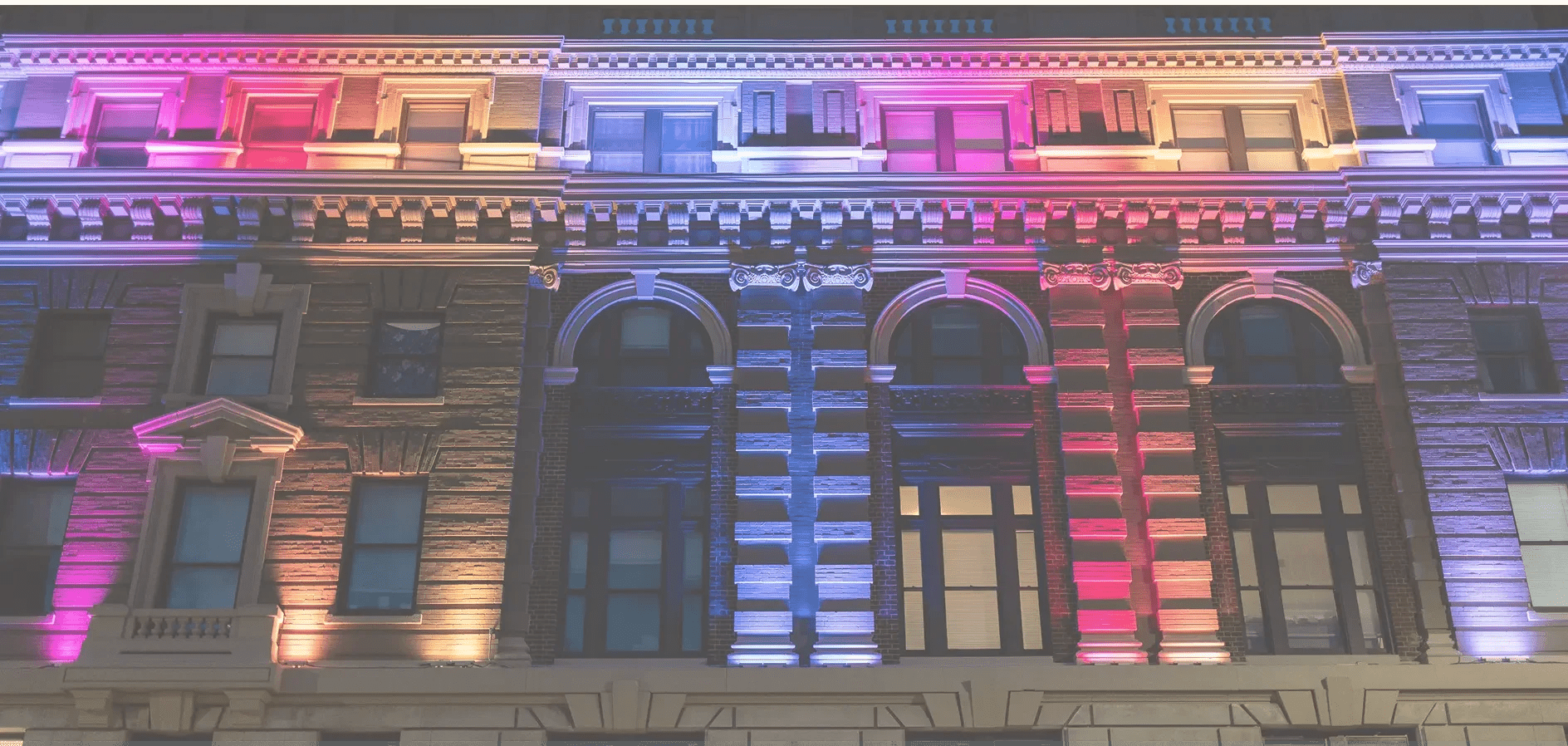
TOUR: If you look at this building right here, this, uh, this is the first building called the Koons Building.
It is the oldest building. It was actually older than the arcade buildings themselves. This was built in 1883 and architecturally probably one of the most significant buildings in, down on Main Street in downtown Dayton.
Narration I'm standing in the center of Downtown Dayton with our tour guides - Dave Williams and Megan Dunn Peters of Cross Street Developers - a company with offices in Dayton, that was one of the leads on the Arcade project.
TOUR: Right now it's in a Halloween mode, so it's yellow, orange, and purple.
BRIAN: So take me back then to maybe. Early days of the arcade, what might I have seen if I walked into that rotunda back in 9 19 0 5, 6, 7?
DAVE: Well, I wasn't alive
BRIAN: Oh, really?
DAVE: but anyway, well, you would've seen horses on the street, right? there were no cars. All the retail was in the downtown urban centers. It wasn't everywhere else. it was the central marketplace for the region. it was your supermarket, so everything was sort of fashioned after that. In the early 1902 construction, So we have a magnetic draw from the north. The south gets pulled to Cincinnati. That's what this place was about. It was really about commerce, about people, businesses. it was everything that you sort of, ironically, what we want today. We've gone around almost full circle 120 years later, trying to figure out how to reinvigorate downtowns because we've taken away all that pedestrian connection, Through the building of big office towers and big lobbies and no longer a connection to you and me as we're walking down the street.
Narration: Dave Williams is the development vice president of the Dayton office at Cross Street Partners. He's also, by most accounts, the heart, soul and brains behind this massive redevelopment project.
DAVE: so I'll go back to a little bit of my background. out of college, I bought my first house in one of the historic districts and it was, it know I was able to do everything 'cause I'm pretty skilled that way, which is a nice benefit.
As I was doing that, I got more and more entrenched into, really. The world of grassroots, urban redevelopment, historic preservation, all those things that really start to reinvigorate and just watching what we could do by just doing.
Narration: This experience - seeing and realizing the opportunity of historic places around the city - helped set Dave up for the Dayton Arcade project. Where others saw failure, a relic of a bygone era, Dave saw potential.
TOUR: So, we're in the rotunda building, and this is probably one of the most recognizable pieces of architecture in the city of Dayton. Uh, it's kind of the crown jewel, what people like to call it. So it's three stories tall with a, a lower level in the, in the basement.
But we've brought it back to that 1902 marketplace feel. So we've redone all of the plaster work and the tin all, we've done all the colors. We color match them, so to be as accurate as possible. And then all the decor leads back to that marketplace heritage. So there are 16 turkeys. They were repainted by the grandson of the original artist, John Lanelle.
Uh, his grandfather painted them originally and then Dave brought him back in to repaint them. And he'll actually be a vendor this year at holidays, which is very exciting. so you'll see the lattice work and the Rams heads, the cornucopia, all of that points back to that marketplace heritage.
Narration: Walking into the Arcade, there's no question it was once a building of great importance and stature. It's hard to imagine that anyone would've wanted to tear this thing down.
Vince Lewis: You're really looking out at the rotunda. and when you, whenever you bring somebody in and you walk in and you see this vast glass dome, and it's just awe inspiring.
Narration: Vince Lewis, University of Dayton Professor and President of the Hub, remembers coming to the Arcade to visit his dad's office when he was young
Vince Lewis: When I was a kid, my dad worked downtown and at a place called Winters Bank, they built the tower at the corner of second and Maine in 19 69, 19 70. Um, it was Winters then now it's the strata cash tower, and. I would come down, ride the bus down, have lunch with dad, and this is where I would come as a kid and hang out, go shopping, do all those things.
Narration At that time, Dave says the Arcade was already looking a lot different than in its heyday.
DAVE: You'd walk into a 1980s looking mall, and that's when they started putting in escalators and cutting holes in floors and putting in elevators and really taking away what was the original purpose.
DAVE: So here we are. All of a sudden, malls are starting to show up, all these national, fast casual food locations are starting to show up. Suburbs are looking better and better every day, there's several cities that had sort of unique places that they could take and turn into an urban mall and try to sort of capture whatever retail was happening to kinda keep it there and make it a unique space and a unique experience. So that's what you'd walk into.
Narration:: Though different from the central market and commercial hub of its origins, the Arcade of the 80s was still a destination for many. Megan Dunn Peters, Marketing and Community Partnerships Manager at Cross Street Partners and native Daytonian- says people still have fond memories of it".
TOUR - Megan: People will come in and say, I have memories shopping here with my grandmother. I came down on the bus, we went to all the other local retail, and they'll describe the smells of caramel corn or other things that they, uh, experience in the space. So Cols Cafe Counter Service has been recreated out at Dayton History, so it still lives to this day.
It still works as a little bit of a, of a counter service as well. But what's interesting as you look at. All the fruits and vegetables, just, I mean, this was it this was the Meyers or the Walmart of, of back then, but a very different twist to it. And what's, and what's really exciting is knowing that, you know, all of the historical figures from Dayton, most notably the Wright brothers who invented flight, they were most likely here as well, because this was such a staple in the community. Paul Lawrence Dunbar. So we're kind of walking on the footsteps of all that history. I'll take a grilled hot dog and a chocolate shake, please. And I'll still get 5 cents back from my 50 cents. Can't beat it.
Narration: As we walked around the Arcade one Wednesday afternoon, it was clear just how many people feel a connection to this place.
Eva: There's a lot of memories here. A lot of families in Dayton have been here for a long time. There's many generations where they come back. So this place is also sort of a, a heartbeat to a lot of families in the community. It was really important that it came back.
Melinda: As a kid. I remember coming downtown to go shopping with my grandma and, um, you know, there was, uh, an elder Beerman down here and, uh, I think at that time it was, I don't know, res or Lazarus or something, but it's, you know, um, having those opportunities.
Come back to life, um, I think is, um, important for, um, our residents and, uh, community.
Nikol: I am a native Dayton. Um, I grew up, uh, coming downtown all the time.
Nikol Williams also remembers the food court. A lot of my family worked downtown. I. Often say that downtown was my playground. Um, we caught the bus. I can remember bus was 35 cents. We would dig in the couch to get 35 cents because 35 cents got you downtown and a transfer. Um, so someplace to go someplace else or to return home for that matter. Then it was a big thing to come down to the arcade and, you know, get something to eat// I mean, going down to the food court was, or McCrory's, it was like a five and 10 store, um, that five and dime, um, where, you know, basically, the early.
Remnants of like a dollar store, a family general, but you know, more localized. It had like, you know, um, pharmacy had little trinkets, you know, do you remember tchotchkes?
Yeah, those were the good old days.
Narration: Though only lasting a couple years, Megan still has nostalgia for the Arcade's holiday celebration - Holly Days
TOUR: So holidays at the arcade is our big holiday festival that we do every year. I was here as a child at the first, uh, the second holidays.
In ways - Holly Days briefly brought the Arcade back to its original purpose - a central place where artisans, businesses and patrons from the community would all gather under one magnificent glass roof to engage in commerce but also another kind of exchange - in-person social interactions. Times had changed, but Holly Days briefly restored the arcade to a vibrant and bustling center of the city. But it would be short lived.
TOUR: the arcade was open in 1992 and 1993 for Holly Days, and it was kind of the last big public event that happened at the arcade.
But then, other major shifts to the commercial and residential landscape of downtown buffeted the Arcade. And after several blows, Holly Days and the Arcade...were finally done.
DAVE: It had failed financially. They resetDid a few things by 91 toast. Point, everybody had pretty much given up on it,
Seg B - Renovation for Innovation
JENN: It was kind of shocking, I guess. Um, it just looked like it had been abandoned and held in some sort of time warp.
Narration: For 30 years the Arcade sat empty as one after another proposal to redevelop, renovate, even demolish failed to find enough funding and support. During that time it was sold for 1$ and later, this historic landmark was listed for sale on ebay. No one wanted it.
JENN: Christmas decorations were still hanging from years before and there was a lot of water everywhere, a lot of mold everywhere.
Narration: Jenn Wiley is the lead designer on the Arcade project and she and others remember the abysmal state it was in.
torn up carpet, broken glass, graffiti on the walls. Uh, there were certain parts we couldn't even walk in because it was so full of water., it was definitely a shock. so my first impression was. Wow, this building needs a lot of work. Uh, it was very deteriorated.
SCOTT: There were holes in the rotunda glass water and, sunlight streaming in. There were carpets that were laid 60 years ago. There was wood that had rotted. So visually you saw these beautiful bones. You knew this place was special, but it was disgusting.
Narration: Vince Lewis, who first visited the Arcade back when his dad had his banking offices there, also remembers the sorry state it was in.
Vince Lewis: When you walked in, I mean, there were Christmas lights hanging from the ceiling that had been there for the. Christmas celebration in 92 or 93 that had never been taken away. A Christmas wreath on the old elevator box, there was a fire extinguisher embedded in one of the glass panels in the rotunda roof.
I have no idea where that fire extinguisher came from, but you know,It was broken in there. There was critters flying around. And we walked into an office and it was obviously like the old property manager's office. And there are 1992 or three yellow pages, the books like Stacks of 'em. There's probably 15 or 20 of 'em in there.
No desk. Everything else is gone, but all this stuff is in there. And it was really like a, you know, did we walk into a zombie movie?
Narration: Why did this once thriving center of the city sit vacant for so long? Well, according to developer Dave Williams, once it started falling into disrepair and downtown cleared out, the scale and cost of the project was staggering. This project in itself, giant in the minds because it had failed twice and nobody could figure out how to do it. But the giant was the capital stack and the funding that we took. 51 sources of funding.
And, $165 million later we're talking today.
In 2013 Dave was brought into the project and he dove right in. Setting up shop in the heart of the arcade.
DAVE: Projects had stalled. The city was trying to figure out what can we do to get things going again. So I was brought in the citywide. We created a place they called Dave's Cave.
I took a big old room down in the basement area and we just started providing vision, which is we go look at a building and we render it and we render ideas. 'cause so much of the cell and any conversation is a pretty picture. But also something that's feasible. Right. Two years earlier, the Mayor, mayor Nan Whaley, uh, ran on tearing down the arcade. That was her win. She won, And it's like, I always like to kid Nan about this because like, oh, Nan, remember you, you, you ran on tearing this thing down. And she, she chuckles, but she's been great.
But it was leadership, right? So at the end of the day, what Nan did is she was fulfilling her commitment to the people that supported her when she said, I'm gonna go and I'm gonna be mayor and I'm gonna deal with the arcade, and if it has to be torn down, we're gonna get it torn down. So we brought in two groups.
One that never saw a building. They didn't want to demolish another one that never saw a building they didn't wanna save tell us what it's gonna cost to do a and tell us can we actually turn this building into something functional?
And so at the end of the day, came down to, it's gonna take $12 million tear it down. To get to zero, right? A gravel lot. Or you can take that $12 million in leverage.
Nobody had $12 million, then you had $12 million to tear it down.
If they were going to save this building from demolition, the first step was basically…triage.
The construction company development partner that we had in an early part of the project because the engineer walked in there.
He goes, this thing's about to fall down. We're all looking at it. I was like, what are you talking about? He goes, put your hard hatt on. I said, well, this building falls down and we have a hard hat. I don't think it's gonna do much, but what we also knew is that if we didn't stop the water, we were not gonna have anything to work with.
So the first thing that came was the city of Dayton putting up, I thought it was seven 50, it might've been a million. And we call it dry and stable. Let's stop the water. Let's keep the building from deteriorating any further. in the meantime. Now you've got the city engaged.
After the city put up money to get the building dry and stable, next came securing funding for the structural work.
It's like, okay, what should we do?So what can we do to save this thing and move it forward? Simultaneously, one of the partners we got, so the capital stack includes, affordable housing.
DAVE: we won a double tranche of affordable housing, one of the first double T tranches ever sort of put out there by offa, which is our local, Ohio funding agency that oversees the affordablecomponent.
DAVE: And we. All of a sudden now have that. It's like uhoh. We get, and so what's challenging about all these sources? They all have timelines.
Available state historic tax credits require a whole process of making application, scoring, winning, losing, winning. And here we have one of the most significant historic preservation projects in Dayton, Ohio,
That being said, as we're removing walls and removing ceilings, we're starting to see bellies, right, bellies and floors.
Eventually they secured funding from a total of 51 sources AND enough local good will to begin the process of actually redesigning and renovating. Which, for a building this massive...and old...and uncared for, was daunting
DAVE: we didn't even understand the construction because the fact that we didn't have any drawings from 1902, and this is probably one of the most unique structurally put together buildings, that one of our engineers had ever seen. And he was a lot more senior than I was.
And been through like all of Cleveland and all those great buildings and knows all the old buildings. He goes, yeah, I've never seen this. And so the challenge is. When you run into that, do you have enough contingency. The historic tax credits became a key element, but what we have to do is you have to manage what is historically significant to what you can remove to be, prepare to go forward with demolition and construction.
JENN: so as part of the work, uh, with it being a historic building. Taking it back to the of historic significance as part of the historic tax credit, um, uh, path. The basement had been up, uh, during one of the renovations, so closing basement, filling the uh, floor back over the basement, then digging out
Narration: Designer Jenny Wiley along with principal architect, Jason Sheets, are part of MODA4, the firm hired to design the commercial, retail, and office space for the Arcade. They talked about the complicated process of determining what stays and what goes, what to restore and what to reimagine in a historic building like this
JASON: So there was structural elements that place to make that happen. Removal of just of flipping how. People and exited and interacted with building. Um, of taking it its original intent,
uh, and how you circulate it through. And structurally, we've been through. Lot of older buildings to point where sometimes just termites holding hands kind of thing.
But, um, you know, I areas that. In the basement some of these that I didn't feel comfortable walking under, uh, for the first time.
Uh, and you know, structurally, you know, people don't see it, but, uh, to be able figure out how to all things together structurally and, and make it work,
Narration: One of the biggest hurdles was that former crown jewel of the Arcade - the glass rotunda
JASON: when they were working on glass, dome to restore that, they const constructed scaffolding, uh, that had set of drawings and engineering just on the scaffolding. That an encyclopedia thick, and I can't remember the, the. Mean, there were, had to be 15, 20 levels of scaffolding before you went up there, didn't you? Yeah. Before they even got to the equipment to get up to the, to the glass. So it, it, um,
JENN: it's three stories from the
BRIAN: I want you to think back to, uh, some of the design choices that you had to make or you, you considered for a historic building or set of buildings like the Dayton Arcade. Um, can you talk a little bit about some of those design choices and, and.
Maybe what you had to consider as you worked with what? What was there?
JENN: Yeah. it's not necessarily what you would expect working with a historic building. Um, a lot of the space didn't necessarily need to return to what it was previously. So there are certain areas like the [00:29:00] Rotunda or the arcade itself, like the North Arcade that. Are very much historic still. But then you get into the spaces like the hub,
While the rotunda was still the visual centerpiece of the Arcade, the HUB - 100,000 square feet. with hundreds of businesses and college students, would be the true center of the new Arcade.
JENN: we are designing for students and entrepreneurs, those were the two main groups of people. Um. So for me it wants to be an energetic space. It wants to be a youthful space. a space where people collaborate with each other and interact with each other. Um, especially people that don't necessarily interact on a regular basis.
Jen wasn't just designing a space, she was designing an experience - one that would create collaboration, education and inspiration
So they wanted entrepreneurs and students to collide so that students got this. education out of being surrounded by people, building their own businesses in the same space. And hopefully then those students go and they do the same thing.
Seg C - Revival
Narration: they weren't just rebuilding the physical infrastructure of the Arcade, the project was meant to rebuild the infrastructure of Dayton as a whole. And that, at its core, was the entrepreneurial, innovative spirit that once defined it.
SCOTT: But a lot of that entrepreneurial edge, that entrepreneurial mission had kind of been lost. and so 2015, I sort of dedicated myself to doing all I could to help rebirth and rebuild that. And the, the arcade's a huge piece of that.
Scott Korndyk is the president of the Entrepreneurship Center that focuses on supporting startups and other small business owners of Dayton. Which was why he was the first guy Dave Williams and his partners called.
I got a call from a developer, actually a bill from Cross Street Partners, and he said, you know, one of the things that we believe kind of in our hearts is that when we do a mixed use redevelopment project, that innovation's gotta have a role in that and I said, well, sure, I'll take a look, Fell in love with it, of course. and The Entrepreneur Center signed the very first letter of intent they had on the 3rd of January would've been 2017.
Narration: The Hub powered by PNC Bank is now the largest University-anchored innovation center in the country, housing nearly two hundred small businesses and support organizations, and hosting more than 550 students across more than 40 University of Dayton and Sinclair Community College classes each semester.
Vince Lewis: Think the vision, the vision that we had when we started this was one, a vision around multidisciplinary.
Vince Lewis is president of the HUB and Executive Director of University of Dayton's Crotty Center for entrepreneurial leadership.
Vince and Scott partnered to make the HUB the core of business education, resources and connection of Dayton.
You know, you wanted to bring students and entrepreneurs together and put them kind of all in the same space and see what you could create, and that was informed by touring a lot of spaces around the country and what we generally would see. I remember walking into one space and you walk in and there's a wall on the left and it has all the donors right.
And then it had their higher education partners and it had the names of all the institutions that were their higher education partners. And I asked the people running the space, so how often do you see somebody from this place or from that place? And they go very rare. So the, the envision was really to create those connections and that engagement and that plays out in so many ways.
Narration: Though very different from the original use and vision for the space, with the help of Jenn, Jason, Dave and the rest of the team, the Arcade has been reshaped to uniquely and effectively accommodate the HUB and its goals and maintain the nostalgia and history that is so important to Vince and so many other Daytonians.
Vince Lewis: When we were first starting, Scott and I would, would chuckle and we'd say, well, you know, we know we're successful when we're walking around the space and we see people in the space and we've never met them.
And that happens a lot. You know, people I don't know. Or they're that are here and you're going, we're, who is that? Um, the other thing is a, a really important personal experience and it was, um, so, you know, this space, my dad was. You know, back in the 1950s was a circulation, I think they called it a circulation manager for, for the Journal Herald, which was one of the two newspapers in Dayton at that time.
And, um, and, and then we, even when, when he was with a finance company and then eventually with the, the bank, he stopped here every day for coffee at Culp's Cafe, at their lunch counter. He would stop in and get a cup of coffee before he'd go to work. And, um. And when he found out I was working on this project, you know, he was like, okay, you ever get that done?
Um, I want to have a cup of coffee there. So, and yeah, we did, we sat right over here on a cold February afternoon before we had our grand opening, um, right after we had taken occupancy and, um, we sat over there and had our coffee. Yeah. What'd he say at that time? Do you recall a conversation? Yeah, he was pretty amazed, you know, seeing it come back to life and, you know, they, they would come that mom and dad come down here for holidays.
When we started up holidays, when, when, I mean that was a brilliant idea from the Cross street folks. I think, uh, Megan, dun Peters, um, had that idea. My dad was just floored. he passed away a little over a year ago. He was 90. they both grew up right down here. My dad was over right by the Oregon district, which is, you know. Half a mile. My mom was a half a mile the other way in Old North Dayton. Um, so, you know, to them this was such a vital part of the community and to see it reborn was very important to 'em.
Narration: Ultimately the Arcade and the HUB at its center, is about the future. Providing a space for businesses to learn, grow, thrive and then spread their wings to repopulate downtown Dayton and restore it to the business center it once was.
Vince Lewis: Dayton is the entrepreneurial spirit.
Dayton, to me is, is kind of the, you know, picture of entrepreneurship. And at one time I think the, the, um. The patents per capita in Montgomery County, were the highest in the country, or something along those lines.
Um, so I think that's kind of who we are as a community. Um, of course, a lot of those companies grew, right? NCR, Mead, Mead, um, Reynolds and Reynolds Standard Register, um, Delco, um, those companies all grew and became either parts of other companies or went public, and eventually we lost a lot of them. And so when we started talking about the hub, one of the things that we talked about and why it was so uniquely essential for Dayton was because there are people who are doing it.– And one of the ways is a new program that we started a year and a half ago with the Entrepreneur Center called Flyer Nest. Flyer Nest is a, it's a, it's a class. This is a, your capstone class in entrepreneurship at ud. And in the program students are really trying to figure out. How to commercialize technology from like Air Force research labs, army research labs.
It's technology that you can license and then, you know, find a, a, a purpose for it and commercialize it. So these students come up with an idea, um, to ensure that chin straps on football helmets are tight and an electronic way to do that, um, using an existing technology [00:42:00] and, um. You know, lo and behold, uh, and, and the platform is a, is a state template called the Technology Validation Startup Fund.
So they're using that as they're creating their business case, and if they wanna carry forward, they can, and they can even apply for a $200,000 grant for the state. So these, so in the first class that we ran last fall, there was a team, a couple of guys, um, uh, Hank Derman and, and Braden Shepherd, and they came up with this football helmet strap idea. And you know, they, they won our pitch competition and got about $76,000 out of it. And then they raised another a hundred thousand dollars from family and friends, and then they raised another $200,000 from the state through the, uh, Ohio Third Frontier, Ohio Department of Development, the Technology Validation Startup Fund, um, with really, you know, the entrepreneur center carrying us all the way.
So these are students who because of, you know, where that capstone course is run right here in the arcade because running it here at the hub, um, it makes it so much easier proximity for our Entrepreneurs Center partners to be in the classroom and all of their, um, collaborators that work with them,
Narration: We talked to one of these UDayton students while she was working the front desk of the HUB
Grace: So being able to work in a space and like this and take classes and be able to meet people who, um, are entrepreneurs right now in real time is very helpful. Um, and it's really a good way to network and make connections with those people as well.
One of those people is Nikole Miller,
Nikol: I'm the Executive Director for the Miami Valley Urban League, um, here in Dayton. And we are where we're mission to move the needle on generational poverty by empowering communities and changing lives.
Narration: For Nikole it wasn't just the beautiful new inside of the HUB that convinced her to move her business, it was the geography of the Arcade - in the center of downtown
Nikol: So part of the reason why the Urban League, you know, made a decision to come down to the arcade one because it's right across from the transit hub.
So, um, moving down to the arcade, what it, it provides us a central location. Like we're right in the heart of downtown Dayton, where we have, um, better access to barrier removals for a lot of our participants. You know, public health is down the street, the courts are down the street, Sinclair Community College, you know, all the places where you get your birth certificate, you know, um, driver's license.
The arcade was always such a core of, you know, the downtown Dayton footprint and I see it developing, you know, and growing into that again.
I hope so. Yeah. Hope it keeps going the way it was going.
It's almost hard to comprehend everything that's going on at the arcade, especially as you picture the vacant, dilapidated space it was just a few years ago. It's not just the new businesses at the HUB. At the Arcade's communal kitchen space, is the Six triple eight kitchen incubator Co-founded by DeBREE-ah Rice
we are a nonprofit, uh, under the OTA foundation where we serve under resourced food entrepreneurs. So we have an open kitchen area that has six stations, so we, we can serve six different businesses at one time. So you'll see the kitchen and there's three kitchens on each side.
And, um, one side has a prep space and the other side has the cook space. So you have countertop, under counter refrigeration, food sink, and then you have your stoves, deep fryers, and you know, different commercial equipment, equipment that you would need to run your business.
Oh my goodness, arcade. Um, it's an attraction I feel like for everybody. It's a historic building. Most people know the arcade. Um, very excited that it was being redeveloped and, um, being brought back. So honestly, when we started thinking about the project, the arcade was just a good fit, they wanted to have something like this in this space because it's centrally located, um, because it's just a, a good fit to the ecosystem for small businesses in Dayton.
The incubator currently houses 14 small food businesses - from a vegan baker to a soul food cafe she does soulful with a Caribbean twist 'cause she's from The Bahamas. So you can get like fried wings and catfish, macaroni and cheese, collard greens, all those yummy foods that kind of stick to you.
Elsewhere in the kitchen Becky Konecki, the director of a new Montessori high school on the arcade's first floor, is baking a pumpkin pie with her son Jude.
So we actually opened up a high school this year, a Montessori high school. Um, and we operate out of the first floor of the arcade.
Um, it's named Val Valor Montessori. And we found the spot and we love it because of how integrated we get to be with the community.
Well, we're up on the second floor, um, in a community kitchen, and we were just washing some dishes up here. Um, we actually cooked some pumpkin pie this morning to share with the other people in the building, so we were washing some dishes from that, so.
We made some pumpkin pie. We usually cook. We try and cook every Friday if we can, and we make various things.
Down in the atrium, another business is setting up for their annual company holiday party
Actually, the theme this year for us is adult prom. So I dunno if you've noticed, um, over in the corner there is a king and queen crown. So we will have a king and queen crown of the night we're bringing in, um, character artists. To draw pictures of, um, all of our employees and their dates.
We have a photographer coming to do like the old style prom photos. Um, and we actually rented the space downstairs as well, um, the tank. And so we're gonna have our party down there with karaoke, DJs, snacks, and food. After the fancy dinner, we'll go down there and party is, um, I've been down there. It's very echoey, like in the center of that circular part.
The businesses and students at the HUB create a steady stream of customers for new restaurants like Table 33 and the Taco and Coffee shop - Lucho.
I love working in this building.
Yeah, we have a lot of people bustling around this area like that are working for the community of Dayton. We have people in the hub and the contemporary. They're in and out throughout their workday, getting their coffee for the day, um, having lunch meetings or sometimes just coffee meetings.
So there's a lot of community down here and that the arcade is kind of like the heart of it all.
This is actually my favorite part of working at Lucho. Um, just the history of Dayton and how far we've come. You know, Dayton is a city of fighters and, um, it's just realy fun to be a part of it and see all the special events that go, go on in here.
The vibe just feels like an elevated part of history. You know, you can tell that a lot of things have, you know, happened in this building.
MELINDA: think it allows people to, to meet and connect, um, somewhere where they can share ideas and talk through possible collaborations and, um, how we can revitalize other parts of Dayton that have.
Um, maybe been asleep for a while. Um, you know, there's at, at one point Dayton was thriving as a kid. I re I remember coming downtown to go shopping with my grandma and, um, you know, there was, uh, an elder Beerman down here and, uh, I think at that time it was, I don't know, res or Lazarus or something, but it's, you know, um, havig those opportunities.
Come back to life, um, I think is, um, important for, um, our residents and, uh, community.
TRACY: we just had a lovely Empower event, which is a women's leadership, um, Dayton area, chamber of Commerce, uh, event. So we did an event on the third floor in what was Main Street, the hub. There we go. And it was beautiful. Absolutely loved it. Um. Gorgeous place. And now we're coming down to table 33, um, to continue our festivities.
I mean, it was fantastic. It was a great environment for us to get to know each other and collaborate. And I mean, honestly, to have something like this downtown Dayton is fantastic because it gives us different opportunities to do different things. I mean, I think you can, well, you can't see 'cause this is a podcast, um, but it's a lovely environment with lots of people. It looks like they're setting up a party in the main area. You can see through these beautiful glass windows, the sky that's definitely going to rain soon. And I'm sure it would be perfect with some candles. Um, so yeah, it's just, it's a great environment.
It's a great opportunity for our community.
Tell me a little bit about what the Dayton Arcade means to the city of Dayton, to the people, to the students.
What do you see? Uh, when we're down here on a busy night and, and you think about the challenges of. Putting together the capital stack, the challenges of deconstructing the building, the challenges of overcoming the, the, the first stinger and the second stinger that didn't work so well in the eighties and nineties.
And now you stand here on a busy night in Dayton, Ohio. Looking at what it is now, what, what do people, what do they experience? What kind of emotions do they have now?
Gosh, where was that? It was, it was a week ago. Anyways, um, thank you. That's probably the biggest thing. I mean, it's, it's, it's interesting to see how emotional it is for people. It becomes emotional for us.
Mm-hmm. Mm-hmm.
Just to watch that reaction and the people come up and shaking their hand and just saying, man, thanks.
I mean it's over and over again. I mean, it doesn't matter where I'm at. Where I speak, where I see people, it's, it's constantly, especially the people that spend a lot of time here Or outta business here or whatever it was. Um, that's what you see is just a big Thank you.
In a city known for invention, the REinvention of the Dayton Arcade with the HUB at its center, is being embraced by enterprising Daytonians, together envisioning a bold new future for their city.
I love that it's being used as an entrepreneur center because I feel like it's being shaped by the ideas of the people here. And, and I don't know where those will go because I feel like every new person who comes gets to bring a little piece of themselves to like creating the future.
And I think that's what's so unique about it.
NARR: If you want to check out videos and photos of the Dayton Arcade, visit us at builtpodcast.com.
CREDITS
BRIAN MAUGHAN: If you want to check out photos of Pearl, visit us at builtpodcast.com. Built is a co-production of Fidelity National Financial and PRX Productions. From FNF, our project is run by Annie Bardelas. This episode was produced by Josie Holtzman with help from Sandra Lopez-Monsalve. Our location producer in Dayton is Austin Fast. Our editor is Genevieve Sponsler. Production support by Adriana Rozas Rivera. Audio mastering by Rebecca Seidel. The Executive Producer of PRX Productions is Jocelyn Gonzales.
Special thanks to our guests, and to Eva Buttacavoli, Ashley Schmitz, Becky Koneki, Grace Shea, Melinda Moore, Taylor Reichert, DeBrea Rice and to everyone else who talked to us at the Dayton Arcade.
Thanks for listening and remember, every story is unique, every property is individual, but we’re all part of this BUILT world.